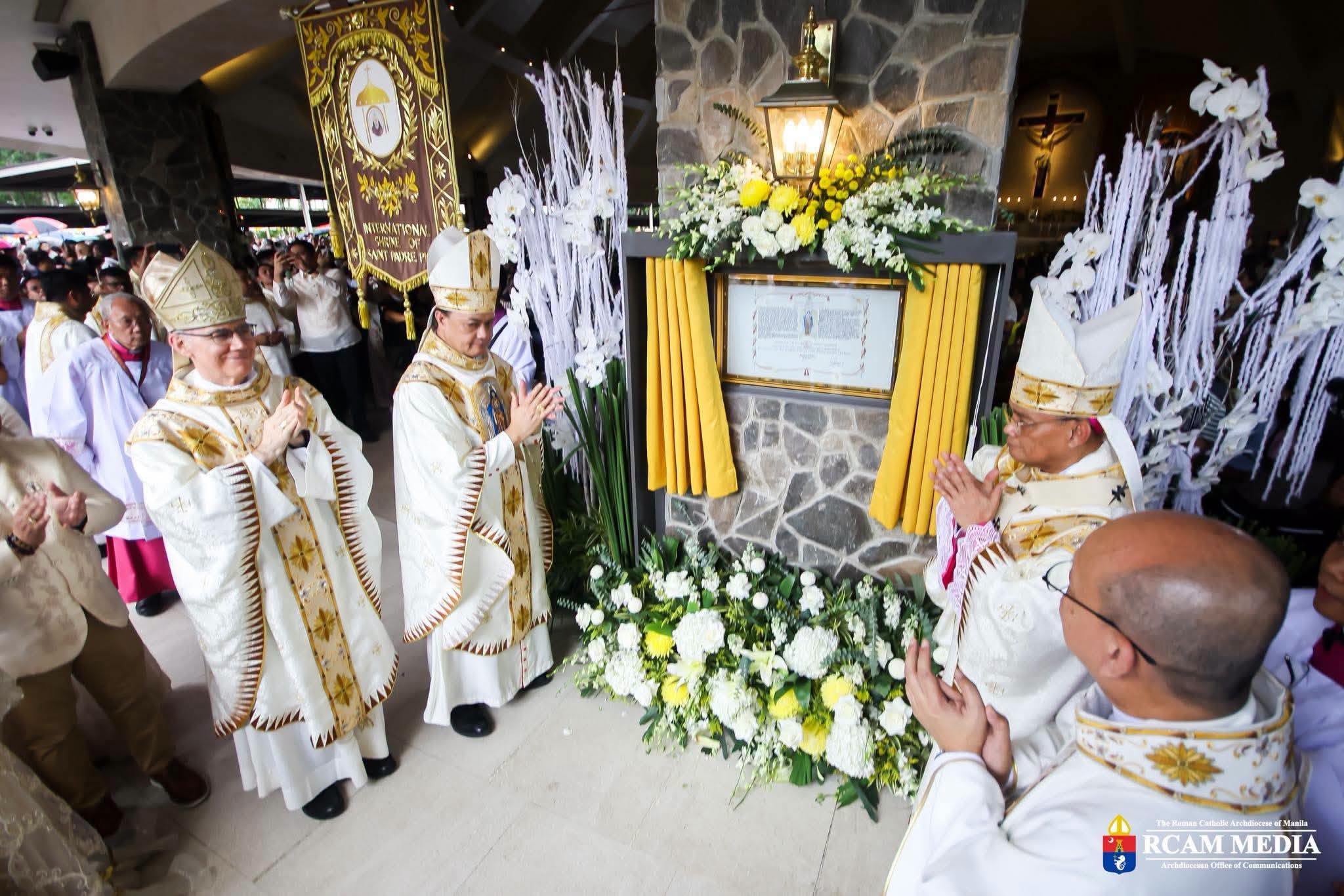

The Dicastery for Evangelization at the Vatican has officially elevated the National Shrine of St. Padre Pio in Santo Tomas, Batangas, to the status of an International Shrine. The decree was issued on May 25, 2026, coinciding with the 139th birth anniversary of Saint Padre Pio of Pietrelcina and marking a significant moment in the history of the shrine.
In a press conference held before the solemn declaration, Archbishop Gilbert A. Garcera of the Archdiocese of Lipa and president of the Catholic Bishops Conference of the Philippines (CBCP) said the Vatican’s decision underscores the importance of the shrine to the local community as well as to the universal Church.
“…this historic decision by the Holy See affirms the sanctuary’s growing role as a major global center of pilgrimage, prayer, reconciliation, and evangelization, while formalizing its spiritual bond with its mother sanctuary, the Sanctuary of Saint Pio of Pietrelcina in San Giovanni Rotondo, Italy,” he said.
Archbishop Garcera, who is also president of the Catholic Bishops’ Conference of the Philippines, expressed gratitude for the elevation of the shrine to an International Shrine.
“This elevation carries profound theological and pastoral significance for both the local and universal Church. For the Archdiocese of Lipa and the Philippines, the decree recognizes decades of unwavering devotion, pastoral outreach, and spiritual growth that have transformed the local center into a sprawling 17-hectare sanctuary. It grounds the vibrant Catholic identity of Asia within the universal communion of faith, establishing the shrine as a principal beacon of hope for the region,” he said.
Embodying St. Padre Pio’s compassion for human suffering, the shrine has long been committed to serving the poor, the sick, and the marginalized, becoming “a living haven of medical, physical, and spiritual healing.”
At present, the shrine holds a monthly Healing Mass every 23rd day of the month, provides holistic pastoral care, and offers accessible opportunities for the Sacrament of Reconciliation. Through these ministries, “the shrine offers dignity, solace, and divine mercy to those carrying heavy burdens of illness or adversity.”
He also said the shrine will enhance the celebration of the Mass by offering it in multiple languages to embrace its diverse community. The Sacrament of Confession will also be expanded to every Sunday, providing more opportunities for spiritual growth.
He added that the shrine is committed to improving its premises to create a serene and welcoming environment. Additionally, the shrine will focus on enhancing the pilgrim experience through clear information, engaging activities, and thoughtful resources. Training programs for staff and volunteers will also ensure a warm, accessible, and prayerful atmosphere for all visitors.
Archbishop Garcera further said that amid political divisions, social anxiety, and global religious turmoil, the Shrine of Padre Pio aims to be a catalyst for peace and reconciliation. He emphasized that the shrine seeks to heal fractured communities and inspire spiritual renewal by inviting the faithful to unite in faith.
“Padre Pio’s timeless message of trust in God and radical charity offers a direct antidote to contemporary despair. By opening its doors as a sacred sanctuary of peace and reconciliation, the shrine seeks to heal fractured communities, inspire spiritual renewal, and unite hearts in an increasingly divided world,” he said.
Before the press conference ended, Archbishop Garcera stated that the elevation is both a “profound blessing and a solemn responsibility,” telling the faithful that the shrine is set to welcome pilgrims from around the globe and share St. Padre Pio’s message of prayer, trust, and love for humanity.
The press conference was followed by a Solemn Eucharistic Celebration led by Cardinal Pablo Virgilio David, Bishop of Kalookan and Vice President of the Federation of Asian Bishops’ Conferences (FABC). The significant event was attended by various bishops from the Philippines and across Asia, including Cardinal Jose F. Advincula, Archbishop of Manila, and Archbishop Anthony Poola of India.
Padre Pio, born Francesco Forgione on May 25, 1887, in Pietrelcina, Italy, was a Capuchin Franciscan friar, priest, and mystic known for his deep spirituality and remarkable gifts.
He entered the Capuchin order at a young age and was ordained a priest in 1910. Padre Pio is best known for receiving the stigmata, the wounds of Christ, which he bore for most of his life, drawing both admiration and scrutiny. He passed away on September 23, 1968, and was canonized as a saint.
The Shrine of St. Padre Pio began as a parish in 2003 and was elevated to an Archdiocesan Shrine in 2008. In 2015, it became the National Shrine of St. Padre Pio. Most recently, the Vatican elevated it to an International Shrine on May 25, 2026.
Photo by Cedric Andre Tan / RCAM Media