
Cardinal Pablo Virgilio “Ambo” David urged Catholic digital missionaries to become agents of forgiveness, reconciliation and communion, reminding them that every person they encounter online should be treated as a brother or sister rather than an enemy to defeat.
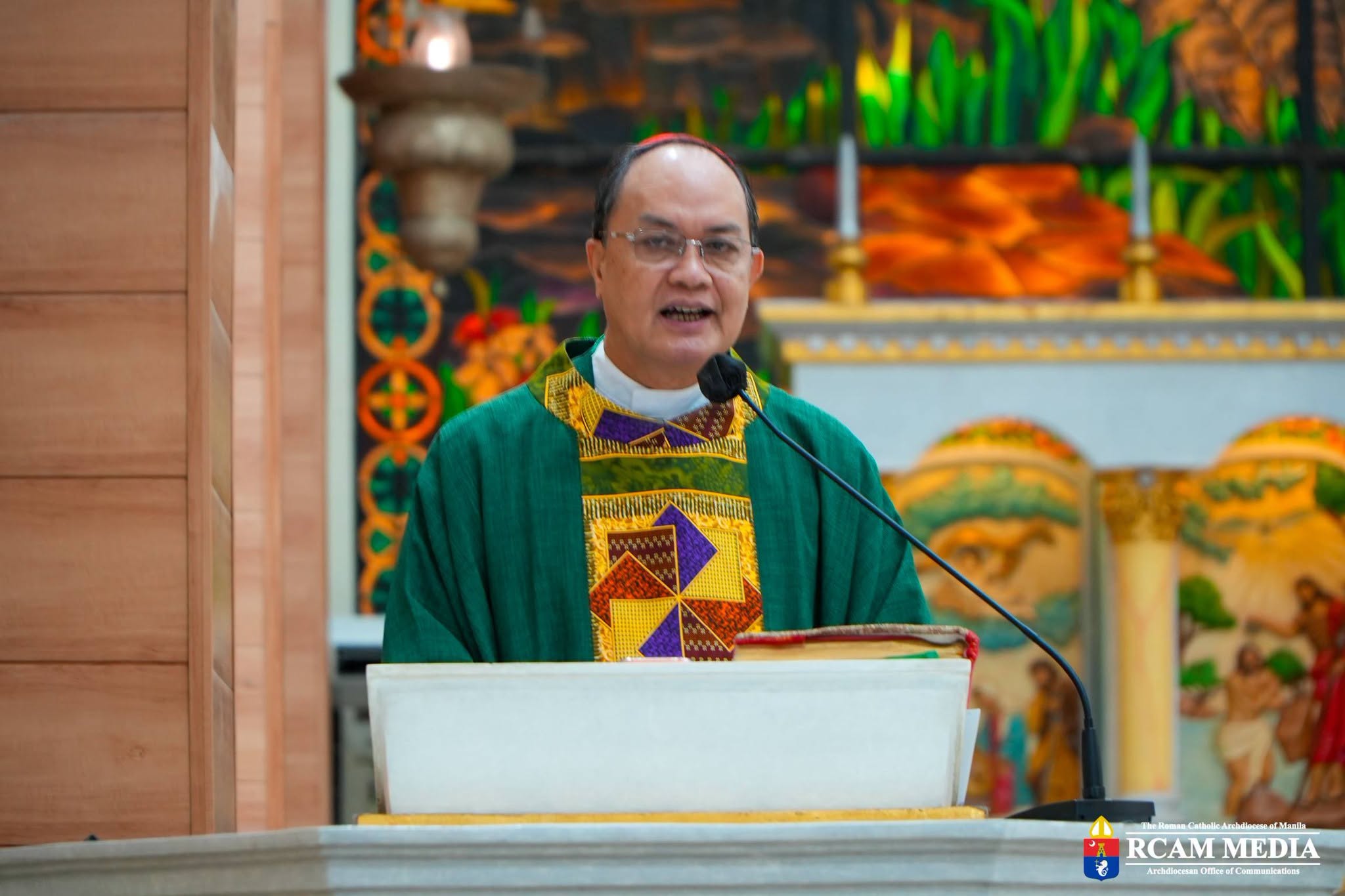
In his homily during the Commissioning and Closing Mass of the FABC Office of Social Communication on September 13 at the Good Shepherd Cathedral, Fairview, Quezon City, he reflected on the Gospel account in which Peter asks Jesus how often he must forgive a brother who sins against him.
The Cardinal stressed that the word “brother” is essential to understanding Christ’s teaching on forgiveness.
“When the one you need to forgive is not another person to you, he’s your brother or sister. There is a bond between you,” he said.
Cardinal David explained that Christianity expands the understanding of family beyond biological relationships. Through baptism, Christians become members of one family under God.
He recalled the words of the late Archbishop Paciano Aniceto, who would often say that “water is thicker than blood,” referring to the water of baptism that binds Christians together.
“If your Father is also my Father, what does that make us? Brothers and sisters. Kapatid,” he said.
Reflecting on Jesus’ response to Peter that forgiveness should be given “not seven times but seventy-seven times,” he said Christ was effectively telling his disciples to stop counting.
He also connected the Gospel message with the Lord’s Prayer, particularly the petition, “Forgive us our sins, as we forgive those who sin against us.”
He explained that Christians cannot continually ask God for mercy while refusing to extend the same mercy to others.
“How can I ask my Father to forgive my countless offenses while refusing to forgive the offenses of my brother or sister?” he asked.
He emphasized that forgiveness does not depend solely on whether the person who caused harm has already asked for it.
Citing Saint Paul’s teaching that Christ died for humanity “while we were still sinners,” he said God’s mercy is offered even before people become deserving of it.
He also reminded the faithful that the Eucharist should never be regarded as an exclusive meal for people who consider themselves perfect.
“The Eucharist was never meant to be an exclusive meal for perfect people. It is a meal for sinners like you and me. In it we partake of a body broken for broken people,” he said.
The Cardinal warned that a world governed only by retaliation can easily become trapped in an endless cycle of violence.
“You hurt me, I hurt you. You attack me, I attack you. Every act of vengeance becomes the reason for another act of vengeance,” he said.
Forgiveness, he explained, breaks that cycle and makes a new beginning possible.
“Without forgiveness, yesterday’s wound becomes today’s resentment, and today’s resentment becomes tomorrow’s violence,” he said.
The Cardinal added that forgiveness is also a conscious refusal to allow the wrong committed by another person to dictate how a victim will respond or what kind of person he or she will become.
“I will not allow hatred to have the last word,” he said.
Addressing participants of the FABC gathering, he said this Christian understanding of fraternity is especially important for those engaged in digital evangelization.
He reminded digital missionaries that the online world has become more than a technological platform. It has become a culture where people interact, search for meaning, experience suffering and express hope.
“Do not go into that world merely as content creators. Go there as missionaries,” he said.
He also identified listening as one of the most important responsibilities of a synodal Church in the digital environment.
“Listen before you react. Listen before you judge,” he said, urging missionaries to pay particular attention to people whose voices are often ignored, including the poor, wounded, lonely, angry, young people and those who have become distant from the Church.
He stressed that authentic listening is more than simply waiting for an opportunity to respond.
“We listen because we believe that the Spirit can speak through the other—even through someone who disagrees with us,” he said.
He also warned that technology’s ability to connect millions of people does not necessarily create authentic human relationships.
“The internet can connect millions of people and still leave them terribly lonely. Algorithms can gather people into groups and still divide them into hostile camps,” he explained.
He challenged digital missionaries to measure their work not merely through follower counts, engagement or online reach, but through their ability to create genuine relationships and spaces of encounter.
“Your mission is not simply to gather followers. It is to build relationships, create spaces of encounter, and help people journey together,” he said.
Photo by John Noel Guarte / RCAM Media | Photogallery